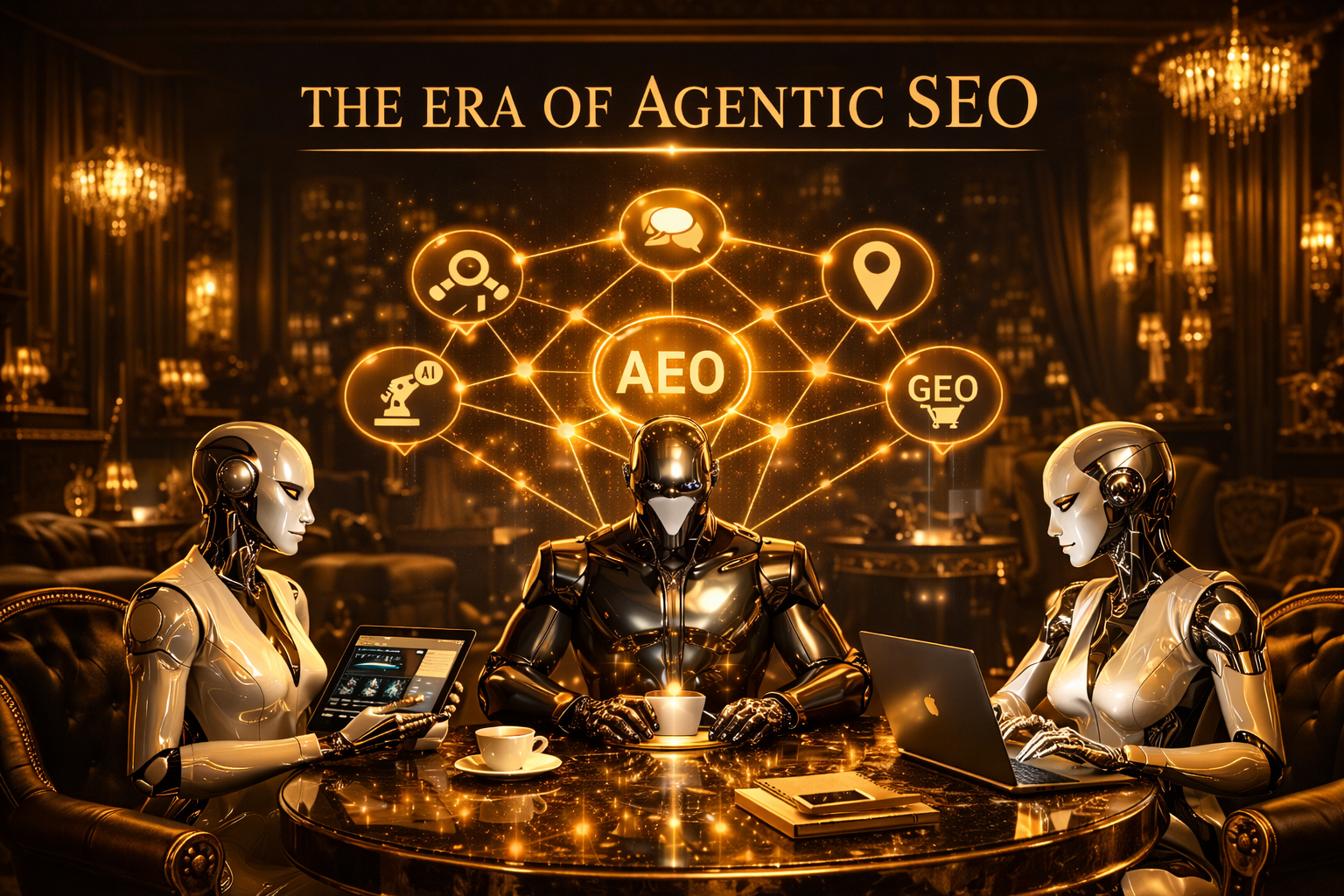
Inside this guide:
Search is no longer a destination; it is a verification layer. In 2026, the traditional search landscape has been completely re-engineered. We are no longer optimizing for clicks; we are architecting data for agents that perform the search on behalf of the user.
The release of Gemini 3 as the global default for Google’s AI Overviews and the recent deployment of Qwen 3 have shifted the benchmarks for technical ingestion. To survive, publishers must transition from standard SEO to Agentic SEO—a paradigm where content is architected to be a "shortcut" for AI deep-research agents.
1. SAGE and the Goal of "Information Co-location"
Groundbreaking research from Google (SAGE: Steerable Agentic Data Generation) has provided the roadmap for how AI agents are trained to browse. Agents are penalized during training if they take too many "hops" to find an answer.
For SEOs, this introduces a new mandatory tactic: Information Co-location. If your page consolidates scattered facts into one comprehensive document, you allow the agent to solve a complex query in a single "hop." This makes your page the "Golden Record" for that intent, effectively short-circuiting the research chain and ensuring you are the primary citation in the AI response.
2. The 2026 Cognitive Model Stack
The "one model for all" approach died in 2025. Today’s elite growth teams orchestrate a specialized cognitive assembly line to produce content that passes the AI Slop filters:
- Qwen 3 (Ingestion King): Specifically designed for technical synthesis and RAG-based extraction. We use Qwen 3 to ensure our data structures are perfectly ingestible by other agents.
- Gemini 3 Flash (Real-time Grounding): With its massive context window and direct integration into Google's live search index, it serves as our fact-checking layer.
- Claude 4.5 (Human Resonance): While newer models focus on raw intelligence, Claude 4.5 remains the leader in "prose texture." It is used to add the human nuance that prevents content from feeling like mechanical output.
- DeepSeek-R1 (Logical Architect): Used to verify the chain-of-thought in our guides, ensuring that we aren't just presenting facts, but building a logical narrative that agents can verify.
3. Agentic Commerce: The Great Filter
Agentic commerce has transformed organic search into a mandatory gatekeeper of AI verification. Marketing arbitrage is dead; Product Truth is the only currency left.
We are seeing a split between two major protocols:
- OpenAI’s ACP (Agentic Commerce Protocol): A walled garden approach where ChatGPT handles the transaction. Merchants are suppliers, but the direct customer relationship (and email LTV) is often lost.
- Google’s UCP (Universal Commerce Protocol): A distributed layer where Google allows merchants to retain full customer lifecycle ownership. However, the competition for the three "slots" in an AI Overview is now a zero-sum game of data integrity.
4. GEO: From Clicks to Ingestion
GEO (Generative Engine Optimization) requires a fundamental shift in technical SEO. Agents don't "browse" your site; they query your API or ingest your JSON-LD feeds.
Your website is no longer a visual destination; it is a structured database. If your return policy, shipping speed, or ingredient list isn't exposed via a clean, agent-readable protocol, you are invisible.
The Information Gain Delta
To be cited in 2026, you must provide Information Gain—the delta between what the AI model already knows from its training set and the unique, proprietary value you provide. If you just summarize the consensus, you will be ignored.
5. The "User Satisfaction" Ranking Signal
Recent DOJ trial revelations confirm that Google’s Glue and RankEmbed systems have moved past simple keyword matching. They now prioritize User Satisfaction as the primary ranking factor.
Google’s AI doesn't just look for "helpfulness"; it predicts whether your page will end the user's journey. If a user clicks your link from an AI Overview and doesn't return to the "AI Mode" to ask a follow-up, your satisfaction score skyrockets. You have solved the problem.
Conclusion: The Future of Authority
Dominating traffic in 2026 requires becoming a technological orchestrator. The machines want data integrity and "Product Truth"; the humans want a premium experience and deep insights. By combining Agentic Automation with elite Copywriting, Kroma is building the blueprint for the next decade of on-chain growth.

Kroma Agentic Team
Research & Intelligence